Research Projects
Current Projects
Smart Buildings and Power Consumption
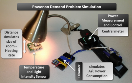
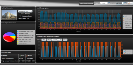
Demand charges can significantly increase electricity bills of large buildings. In order to simulate the Power on Demand problem, I created an algorithm that orchestrates wireless sensors and actuators to reduce peak electricity. Additionally, I developed a service/application to communicate with the building control system at Yale University for the use of its own buildings. This infrastructure allowed me to retrieve utility data and led me to design and to create appropriate representation components in a web portal, with the main goal of easy analysis of the vast number of data. The algorithms behind these components combine power consumption, savings, occupancy, and weather-normalized power consumption.
Intelligent Sensor Driven Messaging System for Wellness Goal Reinforcement
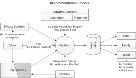
The system uses intelligence extracted from sensors to derive an intelligent messaging scheme that empowers wellness goal reinforcement. It does so by monitoring a person’s behavior and comparing it against a set of prescribed goals to decide the timing, content and destination of communication. For example, in the case of elder wellness, a weekly walking goal may be monitored by sensors that provide the requisite information to our system to compose and send messages to the elders and people in their social circle in a way that encourages the walking activity.
Completed Projects
Power Consumption in AmI Sandbox
Another important issue in a smart home is power consumption monitoring. Various custom circuits have been created that allow to retrieve data from the plugs, including voltages and amperes measurements, as well as to control them (wired and wirelessly), by using technologies and protocols, like Zigbees and Phidgets. The retrieved data saved and used for statistical processing, and the environment suggested to the users how to optimally use electrical power, as well as informed them about the total cost of power consumption.
AmI Technologies Deployment in Hotel Environment
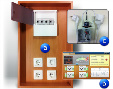
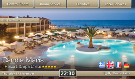
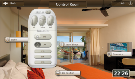
My research in the field of smart home interaction especially the creation of low cost custom-made hardware and user-friendly interfaces has led me to the deployment of AmI technologies in a simulation environment of a hotel room. Utilizing a touch pad, this system allowed visitors to control the appliances in the room and use the facilities of the hotel and local services. A hotel chain owner was attracted by the simulated environment and decided to install the technology as a part of a pilot program in one of his rooms.
Enhancing Health Care Delivery through a Sensors Network Infrastructure
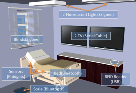
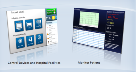
Α smart environment was implementated that employs Ambient Intelligence technologies in order to augment a typical hospital room with smart features that assist both patients and medical staff. In this environment various wireless and wired sensor technologies has been integrated, allowing the patient to control the environment and interact with the hospital facilities, while a clinically oriented interface allows for the vital sign monitoring. The developed applications are used both from a patient’s and a doctor’s perspective, offering different services depending on the user’s role.
Control Home Easily
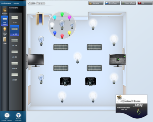
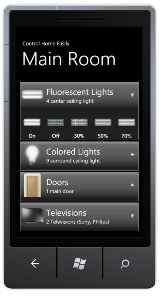
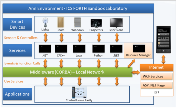
Ambient Intelligence environments contain many smart artifacts and appliances that users can control automatically or manually. In the manual mode, user interacts with intelligent controllers, touch screens or mobile-phones to control electric and electronic appliances in the house. Various research efforts have focuses on the creation of an abstract application that can control every appliance in the environment through smart controllers. Control Home Easily application auto-generates user interfaces and allows users to manage easily home appliances of every room from inside or outside the home with various interactive units through simple touch, like tablets, PCs and mobile phones.
Rapid Prototyping of an AmI-Augmented Office Environment Demonstrator
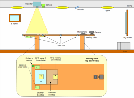
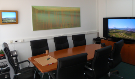
Smart office prototype demonstrates the concept of Ambient Intelligence in a typical office environment. The goal was to maximize the functionality of the devices by providing new interaction methods, and by presenting the information on physical objects (augmented reality). This project was a result of the collaboration between the HCI laboratory and Computational Vision and Robotics Lab (CVRL). My contribution to this project was the creation of: (a) new services to control and to retrieve data from the sensors, (b) an application to present information in deferent types of displays, and (c) the use of augmented reality technology on top of the office table. This project expanded in order to allow multiple users to cooperate on the surface of the table and to use gestures to control the projected information. The new version aimed to improve the exchange of patient information between physicians. Another component of the project was enabling the conversion of 2D MRI scans into a 3D virtual model.
AmIDesigner and AmIPlayer
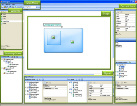
Two tools, named AmIDesigner and AmIPlayer, which have been specifically developed to address the challenges through automatic generation of accessible Graphical User Interfaces in AmI environments. The combination of these two tools offers a simple and rapid design-and-play approach, and the running user interfaces produced integrate non-visual feedback and a scanning mechanism to support accessibility for motor impaired and blind users. AmIDesigner and AmIPlayer have been evaluated to assess their usability by designers, and have been put to practice in the redevelopment of a light control application in a smart environment as a case study demonstrating the viability of the design-and-play approach.
CAMILE: Controlling AmI Lights Easily
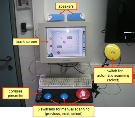
an interactive application for intuitively controlling multiple sources of light in AmI environments, built so that it can be used by anyone, the young, the elderly, people with visual disabilities, and people with hand-motor disabilities alike. In order to accommodate such a wide range of users, we developed three different modes of interaction: (a) touch-screen-based for sighted users with no motor impairments; (b) remote controlled operation in combination with speech for visually impaired users or tele-operation by sighted users; and (c) scanning (both manual and automated) for motor-impaired users.
Other Projects
- Museum eGuide: Applications for Statistical Analysis of Visitors, PDA Rental and Management
- Accessible Flash Games
- Components for "Intuition" Accessible Web Portal